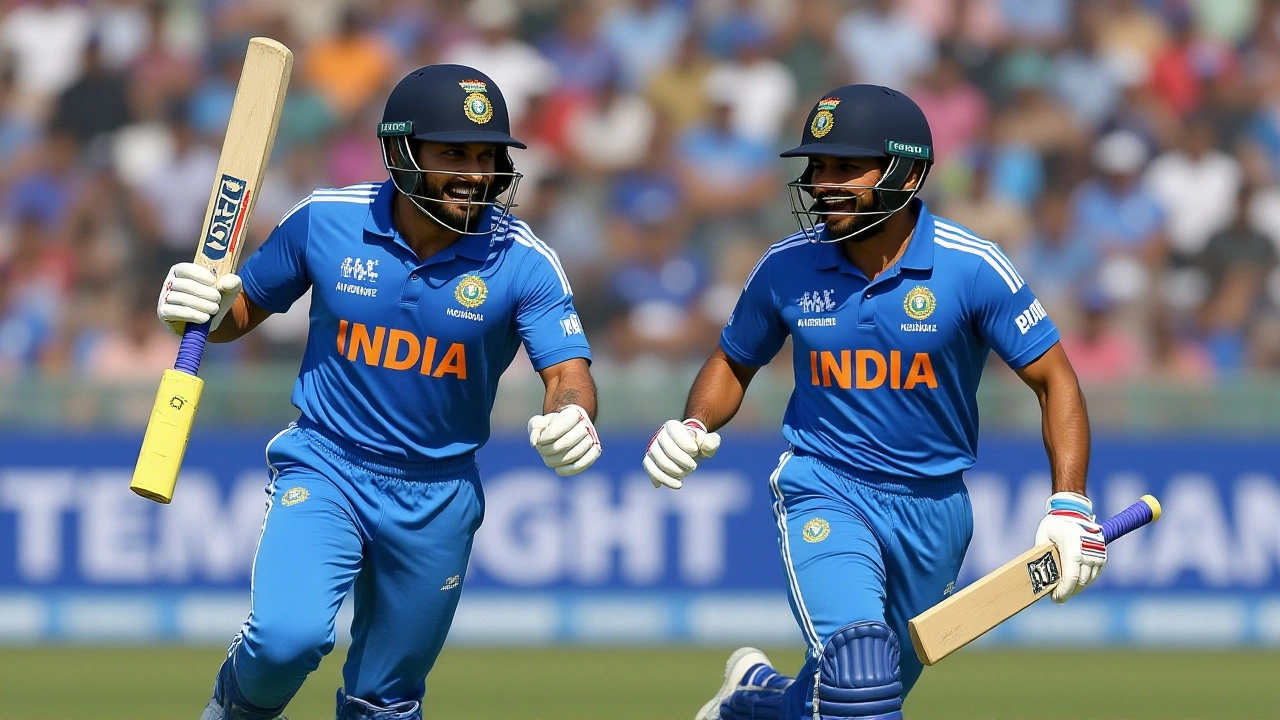
On a crisp November evening in Raipur, two Indian batsmen didn’t just win a match—they rewrote history. Virat Kohli and Ruturaj Gaikwad combined for a staggering 195-run partnership for the third wicket during the second ODI against South Africa national cricket team at the Shaheed Veer Narayan Singh International Stadium on November 24, 2025, eclipsing the 15-year-old record held by Sachin Tendulkar and Dinesh Karthik. The previous mark of 194, set in Gwalior in 2010, stood for over a decade. This time, it fell by a single run—and it felt like a seismic shift.
A Partnership Forged in Fire
Gaikwad, just 22 and playing only his second ODI, came out swinging. His 105 off 83 balls—77 of them to reach his century—wasn’t just fast; it was fearless. He targeted South Africa’s pace attack like a man who’d studied their weaknesses in the mirror. The crowd in Raipur roared as he cracked boundaries through the off-side, often with a flick of the wrist that looked effortless. This was the second-fastest ODI century by an Indian against South Africa, trailing only Yusuf Pathan’s blistering 68-ball ton in Centurion back in 2011. On home soil? Unprecedented. Kohli, meanwhile, played the anchor role with surgical precision. His 102 off 93 balls wasn’t flashy, but it was lethal. He reached his hundred with a single to long-on off Marco Jansen, the same bowler who’d dismissed him in the previous match. That moment—calm, deliberate, almost quiet—was the quietest thunderclap of the innings. It was his 53rd ODI century, according to The Hindustan Times, and his 11th straight ODI match with a century. No one in cricket history has done that. Not Tendulkar. Not Lara. Not Ponting. Kohli is now in a league of his own.Breaking Records, Not Just Scores
This wasn’t just about runs. It was about legacy. Kohli’s 195-run stand with Gaikwad was his 33rd 150-plus partnership in ODIs—surpassing Tendulkar’s record of 32. Gaikwad became Kohli’s 14th different batting partner to join him in such a stand, a testament to how often Kohli has carried India’s batting through the middle overs. ESPNcricinfo noted that this was only the third time two Indian batters had scored centuries in the same ODI against South Africa. The first? Ravi Shastri and Sanjay Manjrekar, in Delhi, on this very date—November 24—in 1991. The second? Tendulkar and Ganguly, in Johannesburg, 24 years ago. Now, history had come full circle. The partnership came at 4.52 runs per over, a relentless pace that shattered South Africa’s plans. Their bowlers, including Lungi Ngidi—who eventually dismissed Kohli in the 43rd over—looked drained, frustrated. Ngidi, who plays for the Titans, had been South Africa’s best hope. But even he couldn’t contain the momentum. India finished at 332/4, their highest total against South Africa in ODIs on home soil.Why This Matters Beyond the Scoreboard
The Board of Control for Cricket in India (BCCI) organized this three-match series as a warm-up for the 2026 ICC Men’s Cricket World Cup in South Africa. Kohli’s form isn’t just about numbers—it’s about perception. After years of speculation over his role in the ODI setup, this back-to-back century streak has silenced doubters. The Hindustan Times put it bluntly: Kohli is “reducing the noise and consolidating his place in the flight that departs for the ODI World Cup in South Africa.” For Gaikwad, it’s a launchpad. He’s not just a promising youngster anymore. He’s now the player who didn’t just share a record with Kohli—he helped break one. His century was the fastest by an Indian against South Africa on Indian soil, surpassing Sanjay Manjrekar’s 80-ball effort in Delhi in 1991. That’s not luck. That’s arrival.What’s Next?
The series isn’t over. The third and final ODI is scheduled for November 26, 2025, at the Greenfield International Stadium in Thiruvananthapuram, Kerala. India leads 1-0 after winning the first match in Ranchi. With Kohli and Gaikwad now locked in, the pressure shifts to South Africa. Can their bowlers regroup? Can their batting find consistency after being bowled out for 227 in Raipur? Meanwhile, social media is ablaze. A tweet from @Shebas_10dulkar on November 30, 2025, confirmed Kohli now holds the record for most centuries in a single format of international cricket—53 in ODIs alone. Tendulkar’s 49 ODI centuries, once untouchable, are now just a footnote in Kohli’s ascent.Behind the Numbers
- Kohli’s 11 consecutive ODI centuries: a global record- Gaikwad’s 77-ball century: 2nd fastest by an Indian vs. South Africa
- 195-run stand: highest partnership by India against South Africa in ODIs
- 33rd 150+ partnership for Kohli: breaks Tendulkar’s 32
- Only 3 instances of two Indian centurions vs. South Africa in ODIs
- South Africa’s 227 all out: their lowest total in ODIs in India since 2019
Frequently Asked Questions
How does this partnership compare to other historic ODI stands in India?
The 195-run stand between Kohli and Gaikwad is now the highest partnership by India against South Africa in ODIs, surpassing the 194-run record by Tendulkar and Karthik in 2010. It’s also the highest third-wicket stand in India’s ODI history against any opponent since 2015. Only two other Indian pairs have crossed 190 in ODIs: Tendulkar-Ganguly (212 in 2001) and Sehwag-Gambhir (215 in 2007). This one stands out for its timing, against a top-tier bowling attack, and its role in World Cup preparation.
Why is Kohli’s 11th consecutive ODI century such a big deal?
No batter in history has scored centuries in 11 consecutive ODI innings. The previous record was 8, held by both Tendulkar and Ricky Ponting. Kohli’s consistency under pressure—especially after a dip in form in 2023—has turned skepticism into awe. Each century in this streak has come against different opponents: England, Australia, New Zealand, and now South Africa. That’s not streaky luck; it’s elite adaptability.
What does this mean for Ruturaj Gaikwad’s future in the team?
Gaikwad has gone from being a domestic sensation to a World Cup-certified performer in two matches. His ability to accelerate without losing control makes him ideal for the middle overs in high-pressure games. With Rohit Sharma’s future uncertain and KL Rahul’s form inconsistent, Gaikwad is now the clear No. 3 for India’s 2026 World Cup campaign. His strike rate of 126.5 against South Africa’s pace attack signals he can handle the toughest conditions abroad.
How did South Africa’s bowling fail to contain the partnership?
South Africa’s plan was to restrict runs early and attack with the new ball. But Gaikwad’s aggressive start disrupted that. Marco Jansen, their most experienced bowler, over-pitched in the powerplay, and Gaikwad punished him. Ngidi, usually a death-over specialist, was brought on too early and lacked rhythm. The field placements were predictable, and India’s batters exploited gaps with surgical precision. Their average economy rate in the 10-30 overs was 6.8—well above their season average of 5.1.
Is this record likely to be broken soon?
It’s possible, but unlikely in the short term. The average ODI partnership for the third wicket is around 70 runs. A 195-run stand is exceptional. Only 12 partnerships in ODI history have exceeded 190. With the ball getting older and field restrictions easing, it’s easier to score—but harder to build such a long, unbroken stand. Kohli’s form and Gaikwad’s emergence make this a rare combination of temperament and aggression that won’t be replicated overnight.
What’s the significance of this match for the 2026 World Cup?
This win in Raipur was more than just a series win—it was a statement. India’s batting depth, especially in the middle order, looks formidable. Kohli’s leadership and Gaikwad’s calm aggression mirror the balance needed in South African conditions. The pitch in Thiruvananthapuram will be slower, and the weather more humid—conditions similar to those in Johannesburg and Cape Town. This match proved India can adapt, score big, and still defend under pressure. That’s the blueprint for World Cup success.